How to Play Memory: Rules, Tips and Three Ways to Play
Memory is the first game a lot of people ever win against an adult. A grid of face-down cards, every picture in it twice, and one question: where did you see the other one? The rules take a minute to explain. Getting good at it takes a little longer, and that is what makes it worth playing with a seven-year-old and with a table of grown-ups alike.
The rules
Shuffle the cards and lay them face down in a grid. Every picture appears on exactly two cards.
- On your turn, turn over two cards so everyone can see them.
- They match: the pair is yours. Take it and turn over two more.
- They do not match: turn them face down again, in the same spots, and the next player goes.
- When the last pair is taken, whoever holds the most pairs wins.
That is the whole game. The one rule people argue about is the second one: in some families a pair does not earn another turn. Braggster plays the common version, where a pair lets you go again.
Board sizes
A bigger board is not just more of the same. With 6 pairs you can hold the whole grid in your head; with 18 you cannot, so the game turns into remembering the right cards rather than all of them.
| Board | Cards | Pairs |
|---|---|---|
| 3 by 4 | 12 | 6 |
| 4 by 4 | 16 | 8 |
| 4 by 5 | 20 | 10 |
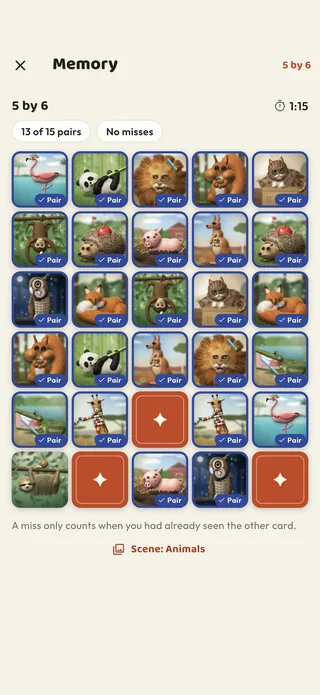
| 5 by 6 | 30 | 15 |
| 6 by 6 | 36 | 18 |
Tips to remember more cards
Give every card a name and a place. "The fox, bottom row, second from the left" sticks far better than a picture you only glanced at. Say it in your head as the card turns.
Watch the other players' turns. Half of the cards you will ever see are turned by someone else. The players who win are the ones still paying attention when it is not their go.
Turn a new card first. When you do not know a pair yet, start with a card nobody has seen. If it matches something you remember, you finish the pair. If you start with a known card instead, you learn nothing new.
Work the edges. Corners and edges are easier to remember than the middle of a big grid, because each has a landmark next to it. Clear the middle when the board starts to thin out.
Do not show off a near miss. On a multiplayer board, a card you turn is a card your opponent learns too. Late in the game, turning two unknown cards can give away more than it gains you.
Three ways to play in Braggster
Memory has one game page with three ways in.
Play solo. Memory solo is a timed puzzle on the Puzzles tab. Your score is your time plus 10 seconds for every known miss: a miss where you had already seen the other card of that pair. Turning a card you have never seen costs nothing, because that is not a mistake, it is the only way to learn the board. Lowest total wins, so your best times on each board size become a record to beat. The cards are painted pictures in four scenes, Ocean, Animals, Space and travel, and Garden and food. A scene only changes the pictures, never the score.
Play here. One phone on the table for 2 to 6 players. After a miss, the cards turn back and the board is covered until the next player taps that they are ready, so nobody gets a free look while the phone changes hands. Or play the computer at Easy, Medium or Hard. It sees every card that turns over, just like you, but it remembers only 40, 70 or 95 percent of them, and it pauses before each card so you can follow its turn.
Play together. Give everyone their own phone at a Live Table, in the same room or online. Only the host's phone ever holds the layout. Every other phone sees the cards that are face up and nothing else, so a guest cannot peek at the board even by digging into the app.
A match can run over several games. Every pair you find is one point, the points add up from game to game, and the starting player moves on each game.
Frequently asked questions
How many cards do you need for Memory? Any even number where every picture appears twice. Braggster uses 12 to 36 cards, from 6 pairs on a 3 by 4 board up to 18 pairs on a 6 by 6 board.
Do you get another turn after finding a pair? In the most common rules, yes: a pair is yours and you turn over two more cards. Braggster plays it that way.
How do you win Memory? Hold the most pairs when the last pair is taken. In Memory solo you play against the clock instead, and the lowest time plus penalties wins.
What counts as a miss in Memory solo? Only a known miss costs time: turning a card whose partner you had already seen, then missing it. Turning a card you had never seen before is free.
Can you play Memory against the computer? Yes, at three levels. Easy remembers 40 percent of the cards it has seen, Medium 70 percent and Hard 95 percent.
Can each player use their own phone? Yes. Start a Live Table and the others join with a QR code or an invite code, on the same Wi-Fi or online. The host's phone keeps the layout and the others only ever see face-up cards.
More: see every puzzle in the app, read how playing together on several phones works, or open Memory and Memory solo in the catalogue.
Memory in braggster: features and scoring
Memory is a trademark of Ravensburger. Braggster is not affiliated with or endorsed by Ravensburger and the name is used referentially only.